Freeze-thaw damage and sealing: what forty winters' worth of expansion does to a Greer driveway
The coast rarely freezes and the mountains stay frozen. Greer does neither: the temperature crosses 32°F forty to sixty times each winter, and every crossing pushes water in unsealed concrete to freeze and expand. Sealing is the cheap, boring, effective answer, and this guide explains why and how.
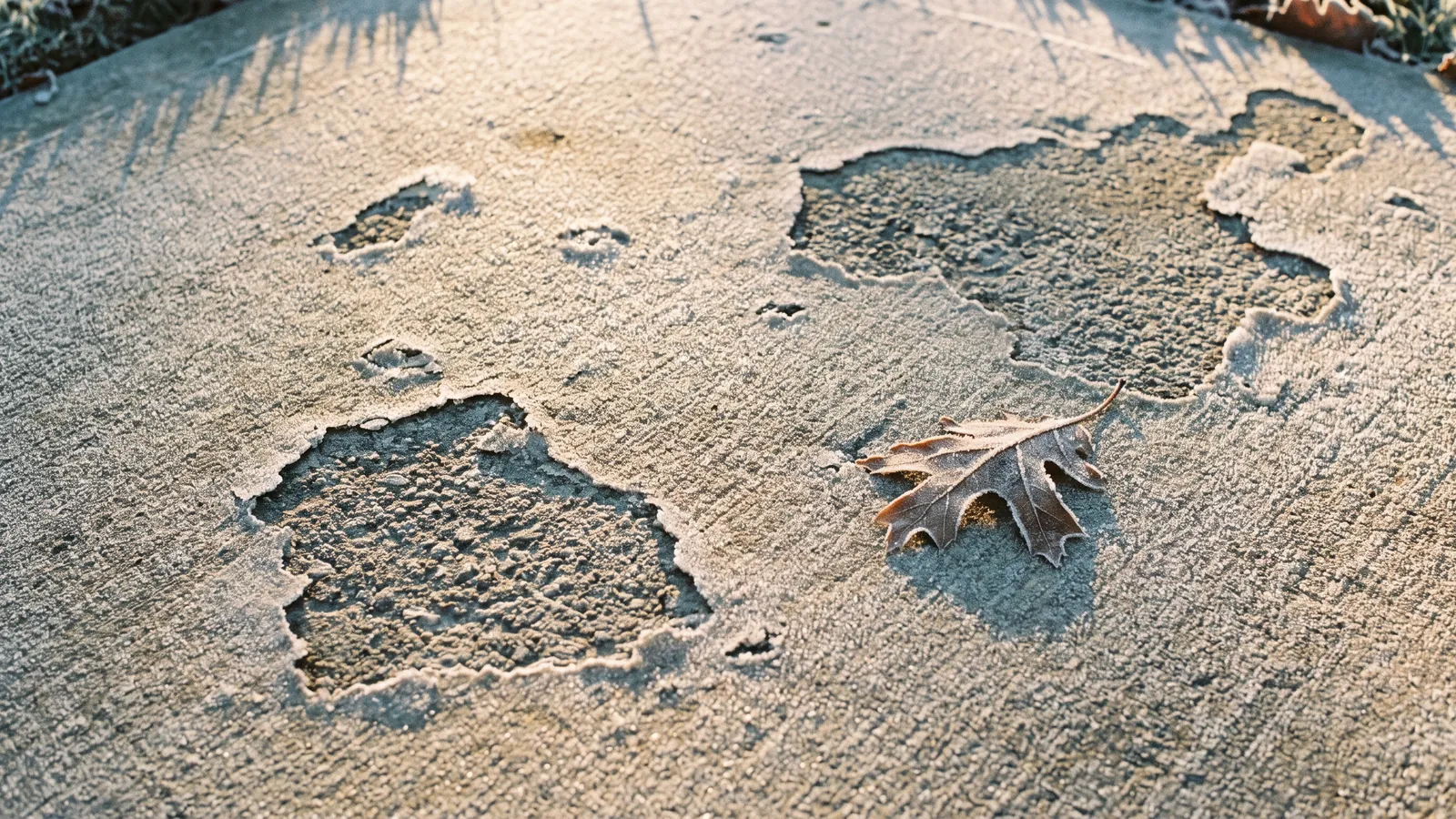
Concrete is porous. Rain, snowmelt and car-wash water soak into its top layer, and in a climate that freezes and thaws repeatedly, that water expands about nine percent each time it freezes, prying the surface apart a little more with every cycle. The Upstate is the one part of South Carolina where that cycle runs dozens of times a winter: cold enough to freeze most nights in January and February, warm enough to thaw by noon. The damage is cumulative and familiar to anyone who has looked at an older Greer driveway.
What freeze-thaw damage looks like
- Scaling and flaking: the top eighth of an inch peels off in sheets or patches, exposing the rougher concrete underneath. Worst on slabs that were never sealed or that had water troweled into the surface on the original pour.
- Spalling at joints and edges: chunks break away where water collected in an open joint or along an edge and froze.
- Widening cracks: hairline shrinkage cracks that water gets into and ice forces open a little further each winter.
- Pitting on stamped surfaces: a decorative sealer that has worn through lets water into the colored surface, which then scales in patches.
Why sealing works
A penetrating sealer, a silane or siloxane, soaks into the concrete and lines the pores with a water-repellent coating. Water beads and runs off instead of soaking in, so there is nothing in the pores to freeze. The slab looks exactly the same, feels the same underfoot, and is not slippery. In this climate the treatment lasts two to three years and then needs renewing, which is quick. Decorative concrete uses a different product: a film-forming acrylic sealer that sits on the surface, gives stamped and stained slabs their color depth and sheen, and wears under sun and tires, so it is renewed on the same two-to-three-year cycle, with grit added on slopes and pool decks.
When to seal
A new slab is sealed about a month after the pour, once it has cured and dried; sealing green concrete traps moisture. After that, every two to three years, on a dry day in spring or fall when the slab is above 50°F and rain is not forecast for a day or two. The best time is before the first winter the slab has not been sealed for, not after the first flaking appears.
What it costs
Sealing runs $1.50 to $4 per square foot in 2026, with pressure cleaning included, so a two-car driveway of about 800 square feet is roughly $1,200 to $3,200 every two or three years. Against a replacement at $4,800 to $12,800 plus removal, or a resurfacing at $3 to $10 per square foot once the scaling has started, it is the cheapest line in concrete ownership. Open joints are re-caulked on the same visit, since an open joint is a direct route for water into the base, which is a different and worse problem than surface scaling.
The other half: the mix and the joints
Sealing protects the surface. A slab built for this climate also uses an air-entrained mix, which has microscopic air bubbles that give freezing water somewhere to expand, and control joints cut at the right spacing and depth the day of the pour so the cracks that shrinkage causes are in the joints and not across the slab. Those are specified on every slab we pour, and they are things to ask any contractor about.
Questions this guide gets asked
Does concrete really need sealing in South Carolina?
In the Upstate, yes. Greer crosses freezing 40 to 60 times a winter, and that is exactly the cycle that scales unsealed concrete. Charleston can get away without it; Greer cannot.
Which sealer should I use?
A penetrating silane or siloxane on plain concrete; an acrylic film sealer, often with grit, on stamped or stained concrete. Do not put a film sealer on a plain driveway unless you want a sheen and a slick surface when wet.
How often?
Every two to three years, sooner for a stamped driveway under daily tires. A new slab gets its first coat about a month after the pour.
Can I do it myself?
Yes, with a quality product, a clean dry slab and a sprayer. The cleaning is most of the work and the reason many people hire it out.
My driveway is already flaking. Is it too late?
No. A flaked slab on a sound base is resurfaced with an overlay and then sealed, and the sealing stops it recurring.
What about de-icing salt?
Avoid rock salt on concrete less than a year old and use it sparingly after that; it speeds freeze-thaw damage. Sand for grip is harmless.
Read next: Sealing and maintenance · Concrete repair · Pouring in Upstate heat and cold · Red clay and your concrete