Settled slabs lifted back where they belong, in a morning, for a fraction of a replacement
A slab that has sunk but not broken does not need to come out. Polyurethane foam or a cement slurry pumped under it fills the void that let it drop, lifts it back to grade and leaves you with the concrete you already paid for, level again, usable the same day.
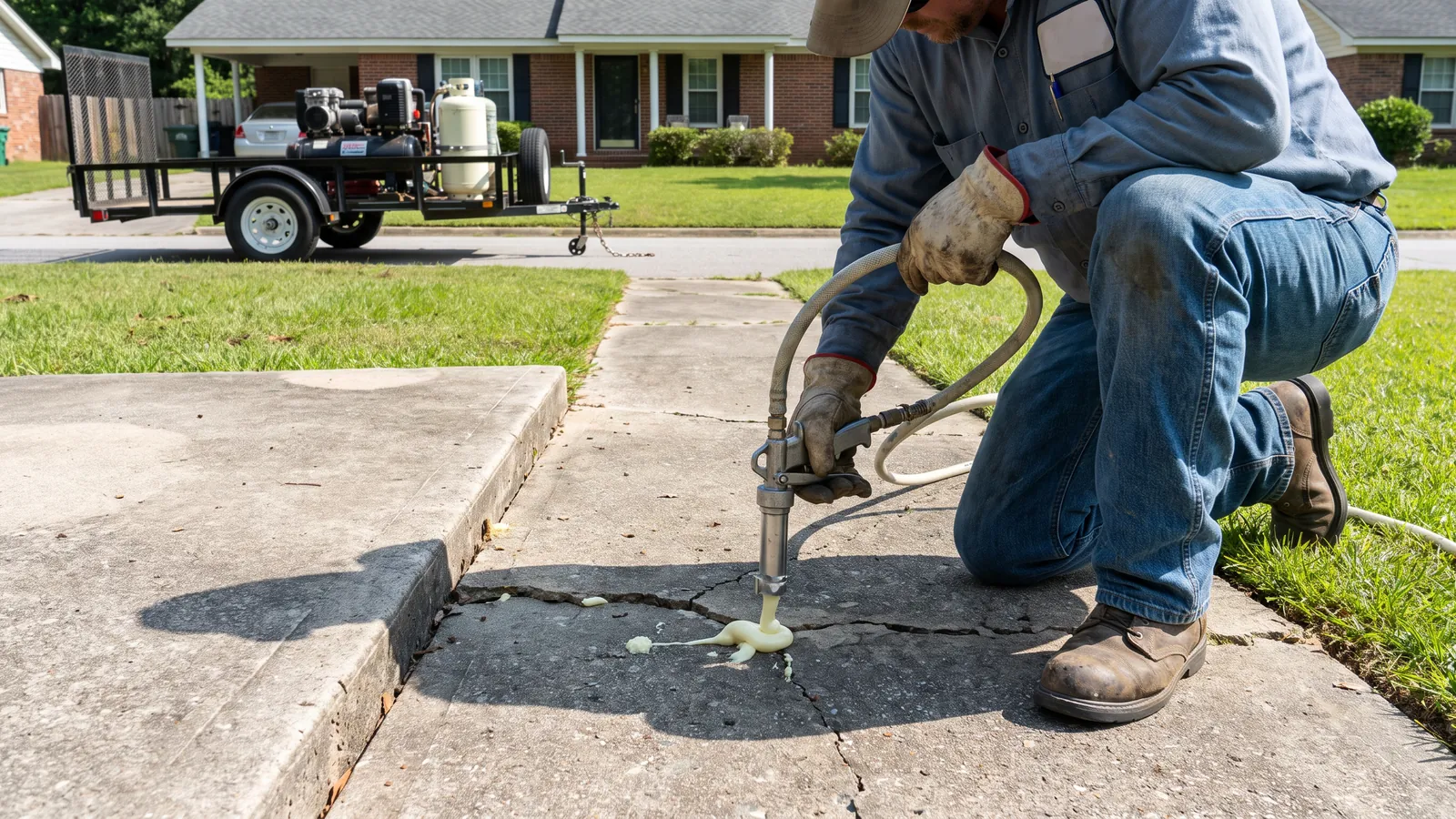
Concrete settles for one reason: the ground under it went somewhere. In Greer that is usually one of three stories. The lot was filled and graded when the house was built and the fill is still consolidating under the slab, which is common across the newer subdivisions along Highway 14, I-85 and the Duncan side of town. Water washed out the base, typically where a downspout empties onto a walk, where the driveway meets the street, or along a patio edge that has no gutter above it. Or the clay shrank in a dry late summer and left a gap the slab dropped into. The symptom is the same: a lip between two slabs, a front walk that tilts toward the house, a garage apron an inch below the floor, a patio that now holds a puddle.
Lifting works by filling the void. Polyurethane foam leveling uses holes about the size of a penny, drilled through the slab; a two-part foam is injected, expands under the slab and raises it in a controlled way while the technician watches the edge come up to a string line. The foam is light, so it does not add weight to a weak base, it is waterproof, it cures in minutes, and the slab can be driven on within hours. Mudjacking, or slurry leveling, does the same job with a cement and sand slurry through larger holes; it is cheaper per square foot and perfectly sound for large plain slabs, heavier to pump and slower to cure. We do both and the estimator will say which suits the slab, the void and your budget.
Leveling is the right call when the slab is in one piece, or a few large pieces, and the base can be stabilized. It is the wrong call for concrete that is cracked into many pieces, for slabs sitting on fill that is still actively settling, or for a driveway whose base has turned to mud; those are replacements on a new base. One thing we will not do is lift a house. Settled footings, foundation walls and crawlspace piers are foundation repair, a different trade with its own engineering, and we will tell you if that is what you are looking at.
What the job includes
Foam or slurry, your choice explained
Polyurethane for speed, light weight and wet ground; cement slurry for large plain slabs on a budget. Both done in-house.
Lifted to a string line
Slabs raised to match the neighboring concrete or the designed grade, not simply pushed up until they stop.
Voids filled, not just lifted
The whole void is filled so the slab is supported edge to edge, and any wash-out point is addressed.
Usable the same day
Foam-lifted slabs take foot traffic right away and cars within hours; slurry needs a day.
Joints re-caulked
The joints that let water under the slab in the first place are cleaned and sealed afterward.
Straight about the limits
Broken-up slabs, actively settling fill and anything under the house are not leveling jobs, and we say so.
Concrete leveling prices in Greer, SC
| Work | 2026 range | What changes it |
|---|---|---|
| Polyurethane foam leveling, per sq ft | $5 – $15 | Void depth and lift height |
| Mudjacking (cement slurry), per sq ft | $3 – $8 | Slab size and access |
| Lifting a two-slab front walk | Priced on inspection | Typically a few hundred dollars, same morning |
| Driveway section at the garage door | Priced on inspection | Lift height and slab condition |
| Patio or pool deck lift | Per sq ft as above | Edge access for injection |
| Joint sealing after lift, per linear ft | Priced on inspection | Recommended on every lift |
| Replacement instead, per sq ft | $6 – $16 | When the slab is beyond lifting |
Budgeting ranges for the Upstate in 2026, drawn from current contractor cost guides. Your figure is written after the estimator has measured the site and checked the ground, and it is itemized so you can see where the money goes.
On site
Concrete leveling questions, answered
Foam or mudjacking: which is better?
Foam lifts more precisely, adds almost no weight, resists water and cures in minutes, and it costs more per square foot. Slurry is cheaper and fine for big flat slabs with room for larger holes. We quote the one that fits the job and explain why.
How long does a lift last?
As long as the base stays put. If the void came from a one-time wash-out that we fix, the lift is permanent. If the fill under a new subdivision slab is still consolidating, the slab can settle again, and we tell you if that is the risk.
Will I see the holes?
Foam holes are about five-eighths of an inch and get patched with matching mortar; from standing height they are hard to spot. Slurry holes are larger and more visible.
Can you lift a slab that is cracked?
A slab in two or three large pieces, yes, each piece lifted to grade. A slab in many small pieces, no; it will not lift evenly and is better replaced.
Can you level my garage floor?
The dropped slab at the door and settled sections in the middle, yes. The garage floor edge that sits on the foundation stem wall has not moved; the slab inside it has.
Do you lift foundations or houses?
No. That is foundation repair, with engineering and permitting behind it, and we will point you to that trade rather than attempt it with slab equipment.